In collaboration with: Royal Castle on Wawel Hill – State Art Collection, EDIH Saxony, SpinLab GmbH (Leipzig)
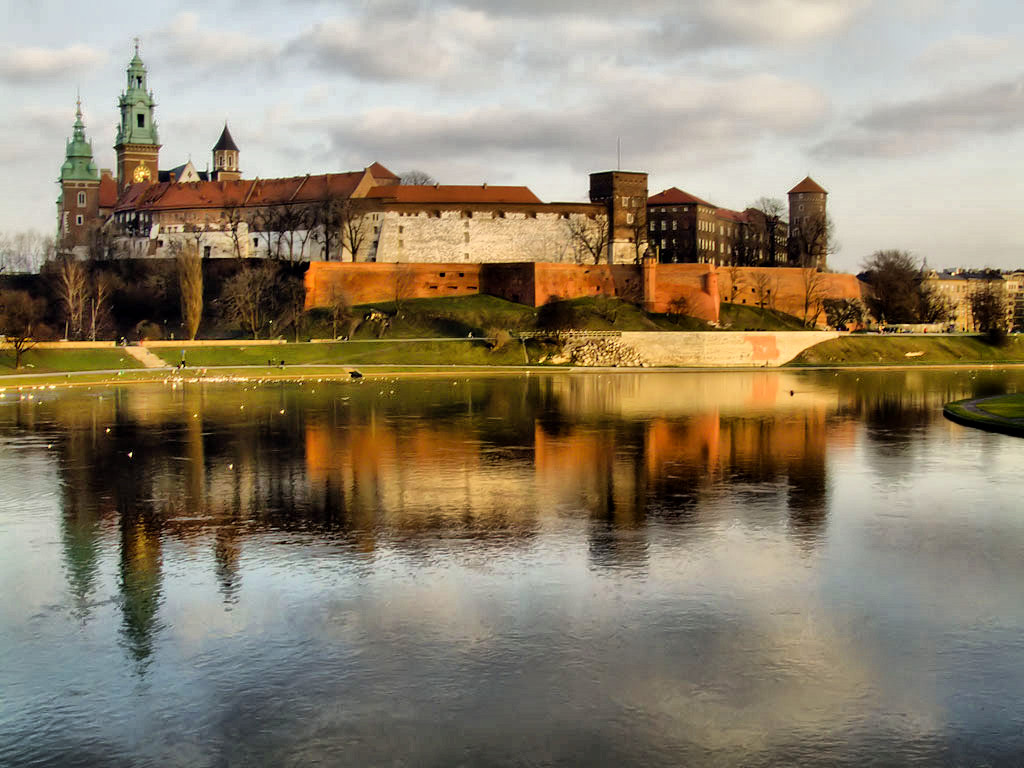
Wawel will become the first site in Poland and the second castle hill in Europe whose structures will be imaged with cosmic-ray particles this year. Wawel Hill is one of the most important cultural heritage sites in Poland and part of the historic centre of Kraków, inscribed on the first UNESCO World Heritage List in 1978. As the residence of Polish rulers since the early Middle Ages, with layers of occupation spanning from the Palaeolithic to the 20th century, it stands alongside Buda, Prague, or the Spanish Alcázar. It now joins a narrow group of heritage sites studied using an imaging technology derived directly from particle physics. The research will be carried out by MUOTECH in collaboration with the Royal Castle on Wawel Hill.
Within the VIEW project (Visualizing the Interior and Exploring Wawel), we will apply non-invasive, heritage-safe muon imaging technology. Muon imaging is a passive method that exploits natural cosmic particles, reaching where classical geophysical techniques face their limits, whether the object is a medieval wall or modern infrastructure. The method has already proven its value in the study of cultural heritage sites worldwide — a notable example is the discovery of a previously unknown void above the Grand Gallery in the Great Pyramid of Giza in 2017. In recent years, a number of studies have been carried out, including investigations of the castle hill of Buda Castle in Budapest.
We will install a muon detector in spaces made available by the Museum. The apparatus will register natural cosmic particles passing through rock, masonry and other dense materials, making it possible to create images of otherwise inaccessible structures. The measurements require no intervention in the historic fabric and do not require suspending the Museum’s normal operations.
The collected data will allow us to reconstruct the distribution of material density, identify structural anomalies and voids, and pinpoint locations that require further diagnostics using other methods.
Muon imaging is already applied wherever intervention in an object or structure is impossible or undesirable: castles, palaces, fortifications, sacred sites, caves, historic tunnels, and other surface and underground structures, as well as engineering heritage. The same detectors that will image Wawel Hill perform equally well far beyond the heritage sector. In energy and construction, muon radiography allows the assessment of dams, tunnels, foundations, and reinforced-concrete structures that cannot be accessed or drilled into. In mining and geology, it enables the localisation of voids, loosened zones, and abandoned excavations. In the security sector, it is used to detect high-density materials, including nuclear materials, for cargo inspection and critical infrastructure control. Regardless of the sector, the client receives the same product: a map of the density distribution of the structure studied, together with a report on identified anomalies. The common denominator is always the same: a passive method, without intervention in the object and without interrupting its normal operation.
The project is carried out under the Feasibility Collaboration EDIH Saxony programme, co-funded by the European Union.
Scientific support: Dr Ewelina Miśta-Jakubowska (Institute of Archaeology, Jagiellonian University / National Centre for Nuclear Research)
